

When housing stopped being local
Part 16 of the Real Estate Transparency Series
To start at the beginning of my Transparency Series, go here. Part 1
During the foreclosure crisis, I learned something that changed the way I look at real estate.
I learned what happens when the people making decisions about a home have never actually seen it.
At first, that sounds impossible. How can someone approve repairs, negotiate contracts, determine value, or manage a property without ever visiting it?
Yet during the foreclosure years, it happened every day.
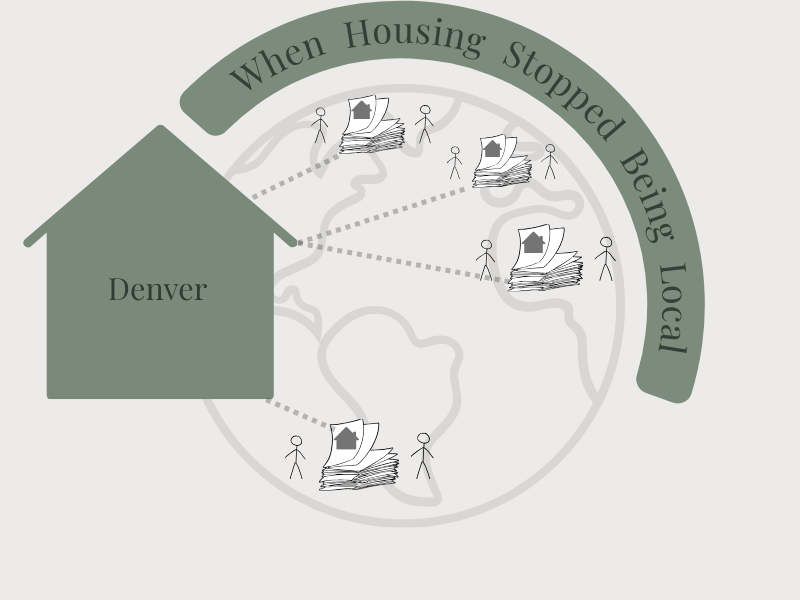
As foreclosure homes in Denver and across the country moved from homeowners to banks, decisions that were once made locally were increasingly handled by asset managers, servicers, attorneys, contractors, and investors located hundreds — sometimes thousands — of miles away. Sometimes in another country entirely.
The further decisions moved from the property, the more disconnected the process became.
And the people living next door paid for it.
How we got here
Remember when everyone got a mortgage?
Back in the early 2000s, lenders were qualifying buyers on almost anything. The goal was volume, and volume is what they got. Those mortgages were packaged together and resold to the highest bidder.
So what happens when the highest bidder isn’t from the United States?
In an ideal world, nothing. A loan is a loan. A payment is a payment.
But the mortgage crisis was anything but ideal. And what was already a mess got messier.
When those loans went into foreclosure, the bank manager did not fly to the United States to handle it. The system that emerged was layered: an out-of-country bank hired an asset manager, who hired a service provider, who eventually hired someone local.
Each step of the foreclosure process had to be outsourced down the chain.
That model works fine for manufacturing. You can manage a supply chain from overseas. You can track inventory by spreadsheet.
You cannot do that as well with people and homes.
By 2009, foreclosure homes in Denver were flooding the market. The people responsible for managing them were working from reports, spreadsheets, and automated systems — making decisions about properties they had never visited, in neighborhoods they had never seen, in a market they didn’t understand from the ground.
The house became a file.
Real estate used to be local
For decades, real estate worked the way you’d expect.
The homeowner lived in the home. The lender often operated in the community. The people involved understood the neighborhood, the condition of the property, and what was actually happening on the street.
If a house had a drainage problem, people knew. If a subdivision was improving, people knew. If a property backed to a busy road, local buyers understood what that meant for value.
Local knowledge wasn’t a feature. It was the foundation.
The foreclosure crisis dismantled that foundation one outsourced decision at a time.
“Just jiggle it. Try a little WD-40.”
That was the guidance I received when a lockbox on a foreclosure property would not open.
I hadn’t realized I’d enlisted as a maintenance man. I just wanted a smooth showing.
To get anyone physically out to the property, the request had to be outsourced — which meant several days of waiting. Agents couldn’t get inside. Buyers couldn’t see the property. The home sat on the market while the solution offered by the out-of-state asset manager was to jiggle it.
We never did find out what happened with that house. My buyer and I moved on.
That was the foreclosure system at street level. A home sitting on the market, inaccessible, managed by someone who had never seen it.
The house with a history nobody disclosed
Another foreclosure looked normal from the street.
Inside was something else entirely.
A smell I couldn’t identify. Walls so intensely yellow you could see the outlines where pictures had hung — not from age, but from chemical residue. A large pile of dirt on the floor. Broken chemistry beakers. Antifreeze.
The home had previously been used as a methamphetamine lab.
Nobody should have been walking through that door — buyers, agents, or anyone else — whether they knew what they were walking into or not. A former meth lab requires licensed remediation and environmental testing before it is safe for anyone to enter.
There is no standard training for this. No checklist handed to agents that says here is how to identify a former meth lab before you walk through the door. I went home and asked Google what the signs were.
When I called the listing agent he got angry.
“I haven’t even been inside it,” he said. “But the cleaners would have said something.”
Nobody knew what the cleaners had cleaned?
Broken glass. Antifreeze. A large pile of dirt on the floor.
That property should never have been listed as accessible to the public. It wasn’t a disclosure problem. It was what happens when nobody with actual responsibility has actually seen the property.
The appraisal that revealed the gap
One foreclosure transaction still stands out.
The buyers went under contract. The price seemed reasonable to everyone involved — including the asset manager working from a spreadsheet in another country.
Then the appraisal came back $100,000 above what the buyers were paying.
The buyers benefited — they walked in with equity from day one. But step back and look at what that gap actually means.
The asset manager had no idea what they had. They priced a property without understanding the neighborhood, the condition, or the local market. A local professional would have known. The disconnect that created problems in the meth house and the lockbox story created an accidental windfall here.
It wasn’t skill on the seller’s side. It was absence of knowledge.
Local market knowledge isn’t a soft skill. It’s the difference between a number and an understanding.
The impact on Denver neighborhoods
Foreclosure homes in Denver affected far more than the individual properties involved.
Vacant homes sat longer than traditional listings — sometimes far longer — because approvals moved slowly through distant management chains. Maintenance was delayed. Landscaping deteriorated. Repairs waited on multi-layered approval processes that had no urgency because nobody involved lived near the property.
Neighbors noticed. Buyers noticed. Entire blocks felt the effect.
Real estate is connected in ways that spreadsheets don’t capture. One neglected property affects nearby homes. One distressed sale shapes future appraisals. One vacant house changes how buyers perceive an entire street.
Housing doesn’t exist in a database.
It exists in neighborhoods. And neighborhoods absorb every decision — good or bad — made about the properties within them.
When housing became an investment strategy
During the foreclosure crisis, housing shifted from a local business to a national investment strategy. Institutional investors, private equity firms, and large corporate owners began purchasing homes at a scale most local buyers couldn’t compete with. Decisions about Denver neighborhoods were being made in boardrooms that had never seen a Colorado street. The experience taught me that housing works best when the people making decisions understand the properties, the neighborhoods, and the communities involved.
What 2009 taught me
People across the United States were losing their homes and their jobs at the same time. Local communities were absorbing the impact. It would have made sense to manage the foreclosure process more locally — with people who understood the market, knew the neighborhood, and were accountable to the community where the home actually sat.
But hindsight is 20/20.
The system that existed prioritized financial structure over physical reality. And the physical reality was a house on a Denver street with a lockbox that wouldn’t open, a meth lab that nobody disclosed, and an asset manager who didn’t know what they were selling.
Technology helps. Data helps. Systems help.
But none of it replaces knowing the property, understanding the neighborhood, and being accountable to the people affected by the outcome.
Because housing isn’t inventory.
It’s a community.
And the most important information is rarely in the file.
It’s standing right in front of the house.
Article summary
This article examines foreclosure homes in Denver, the role of institutional investors during the housing crisis, and how large-scale remote asset management changed the relationship between housing, neighborhoods, and local real estate markets. It is Part 16 of the Real Estate Transparency Series at bestdenverhouses.com.
There is more to this story. The foreclosure pipeline didn’t just create problems at the property level — it created a chain of financial products that most consumers never fully understood. In Part 17, we’ll look at short sales: what sellers thought they were getting, and what some of them actually received.
New to the series? Start with Part 1 at bestdenverhouses.com
Wondering about the market? Reach out.
— Leslie Scholfield | Best Denver Houses